
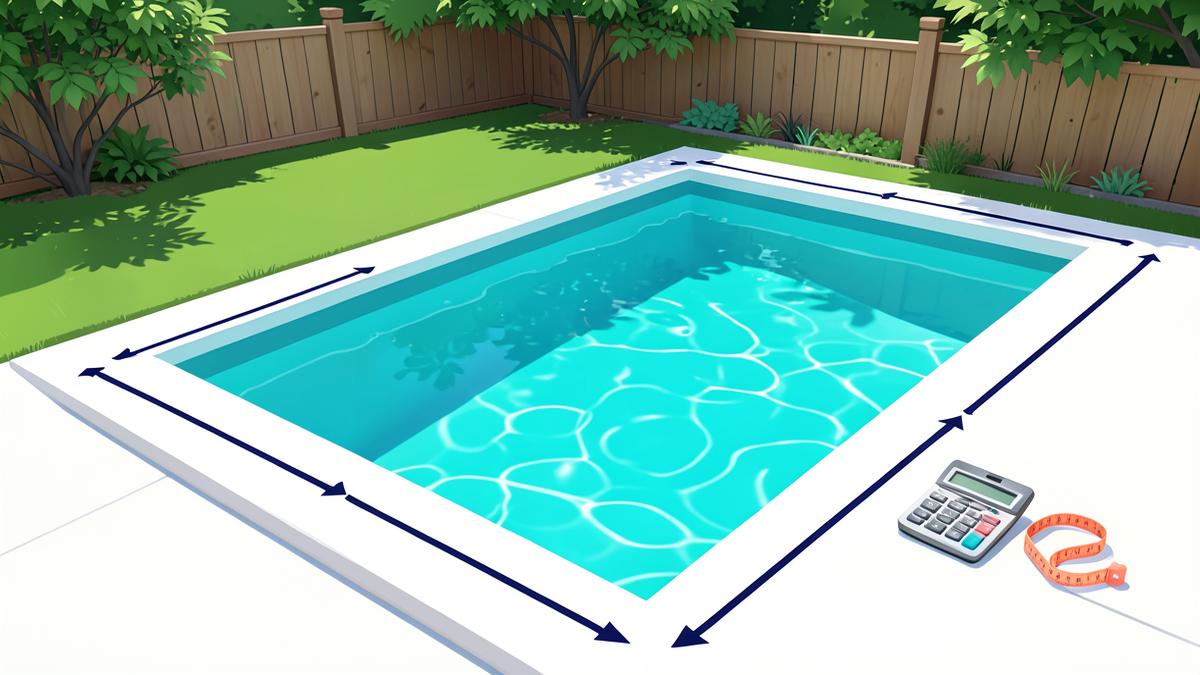
The one formula behind every shape
Pool volume is area times depth. The shape only decides how you get the area. Once you have cubic feet, one constant converts it to the unit you want.
Volume (US gallons) = Surface area (sq ft) x Average depth (ft) x 7.48052
For litres: cubic feet x 28.3168. For metric pools: cubic metres x 1,000 = litres.
The number 7.48052 is not a rounded guess. One cubic foot of water holds exactly 7.48052 US gallons. Rounding it to 7.5 adds about 0.27 percent, which is roughly 52 extra gallons on a 19,000 gallon pool. That is small for a water bill and large enough to skew a chlorine dose, so use the full constant.
Formula quick reference by shape
Pool volume formulas, output in cubic feet
| Shape | Volume formula (cu ft) | Constant and why |
|---|---|---|
| Rectangular or square | Length x Width x Average depth | None, the area is a true rectangle |
| Round | Diameter squared x Depth x 0.7854 | 0.7854 = pi / 4 |
| Oval | Length x Width x Depth x 0.7854 | 0.7854 = pi / 4 for an ellipse |
| Kidney | (Width A + Width B) x Length x Depth x 0.45 | 0.45 is the accepted kidney factor |
| Freeform or lagoon | Average length x Average width x Depth x 0.85 | 0.85 trims the curved edges |
| Triangular | Length x Width x Depth / 2 | Half of the enclosing rectangle |
| Octagon | Width squared x Depth x 0.8284 | 0.8284 = 2 x (root 2 minus 1) x 2 |
| Hexagon | Width squared x Depth x 0.8660 | 0.8660 = root 3 / 2 |
| L-shaped or T-shaped | Sum of each rectangle | Split first, then add |
| Figure-8 | Two circles minus the overlap | Treat as two rounds x 0.90 |
Prefer to skip the arithmetic? The pool volume calculator runs all twenty shapes with these exact constants and shows the working under every result.
Rectangular pool volume formula
Gallons = L x W x D x 7.48052
Measure inner wall to inner wall, not the coping or the box size.
- A 16 by 32 ft pool: 16 x 32 = 512 sq ft of surface.
- Average depth 5 ft: 512 x 5 = 2,560 cubic feet.
- Gallons: 2,560 x 7.48052 = 19,150 US gallons.
- Litres: 19,150 x 3.78541 = 72,491 litres.
That 19,150 figure is the one most 16 by 32 owners quote, and it assumes a 5 ft average depth. Run your own numbers on the rectangular pool volume calculator if your deep end is longer or shorter than standard.
Round pool volume formula
Gallons = Diameter x Diameter x Depth x 0.7854 x 7.48052
You can also write it as pi x radius squared x depth.
A 24 ft round above ground pool filled to 4 ft: 24 x 24 x 4 x 0.7854 = 1,809 cubic feet, which is 13,536 gallons. Fill the same pool to 4.33 ft, the usual water line in a 52 inch wall, and it holds 14,653 gallons. That 1,100 gallon gap is exactly why wall height and water depth must not be mixed up. Check yours on the round pool volume calculator.
Oval pool volume formula
Gallons = Length x Width x Depth x 0.7854 x 7.48052
An oval is a stretched circle, so it uses the same pi over four factor. A 15 by 30 ft oval at 4 ft deep holds 10,575 gallons. Use the oval pool volume calculator when your pool has straight sides with rounded ends, which is common on framed above ground models.
Kidney and freeform formulas
Kidney gallons = (A + B) x Length x Depth x 0.45 x 7.48052
A is the widest part, B is the narrow waist, both measured across the pool.
Kidney pools curve in at the middle, so the 0.45 factor removes the area a rectangle would wrongly count. Freeform and lagoon outlines use 0.85 against an average length and width instead. Both factors are approximations, so expect a result within about 5 percent. See the kidney pool volume calculator and the freeform pool volume calculator for shape specific inputs.
Average depth on a sloped floor
Most inground pools slope from a shallow end to a deep end. Using the deep end alone can overstate volume by 40 percent, which wrecks every chemical dose that follows.
| Floor type | Average depth method | Example |
|---|---|---|
| Flat floor | Depth as measured | 4 ft everywhere = 4 ft |
| Constant slope | (Shallow + Deep) / 2 | (3 + 8) / 2 = 5.5 ft |
| Hopper bottom with a flat shallow section | (Shallow + Shallow + Deep + Deep) / 4 weighted by area | (3 + 3 + 8 + 5) / 4 = 4.75 ft |
| Two clear sections | Work out each section, then add the volumes | Shallow half + deep half |
Always measure depth from the waterline to the floor. Wall height includes freeboard, the dry band above the water, and counting it inflates volume by several hundred gallons on a typical above ground pool.
Metric version of the same formulas
In metres the math is simpler because one cubic metre is exactly 1,000 litres. A 8 x 4 m pool at 1.5 m average depth is 48 cubic metres, or 48,000 litres, or 12,680 US gallons. Every formula above works unchanged. Swap the 7.48052 step for a x 1,000 step.
| From | To | Multiply by |
|---|---|---|
| Cubic feet | US gallons | 7.48052 |
| Cubic feet | Litres | 28.3168 |
| US gallons | Litres | 3.78541 |
| US gallons | Imperial gallons | 0.832674 |
| Cubic metres | Litres | 1,000 |
| Cubic metres | US gallons | 264.172 |
Common mistakes that throw the number off
- Using wall height instead of water depth, which overstates volume.
- Measuring the outside of the frame or the coping instead of the water surface.
- Rounding 7.48052 down to 7, which loses about 6 percent.
- Applying the deep end depth to the whole pool.
- Forgetting attached spas, tanning ledges and spillways, which add real gallons.
Related video
pool volume formula FAQs
What is the basic pool volume formula?
Surface area multiplied by average depth gives cubic feet. Multiply cubic feet by 7.48052 for US gallons, or by 28.3168 for litres.
Why is 0.7854 used in round pool formulas?
0.7854 is pi divided by four. It converts the square of the diameter into the area of a circle, so diameter squared times 0.7854 equals the circle area.
How do I find average depth in a sloped pool?
Add the shallow end depth to the deep end depth and divide by two for a constant slope. For hopper bottoms, work out each section separately and add the volumes.
Is 7.5 gallons per cubic foot accurate enough?
It is close but not exact. The true value is 7.48052. On a 19,000 gallon pool the shortcut adds about 52 gallons, which is enough to shift a shock dose slightly.
How do I calculate an L-shaped pool?
Split it into two rectangles at the inside corner, calculate each one with length times width times average depth, then add the two volumes together.
More pool guides
- Pool Volume by Size: Full Gallons Chart
Look up your pool size and read the gallons straight off the chart, no math needed.
- Average Pool Volume by Pool Type
What a typical pool holds, by type, plus what the average costs to run.
- Pool Chemical Dosing by Water Volume
Dose charts per 10,000 gallons for chlorine, pH, alkalinity, salt, stabiliser and calcium.