
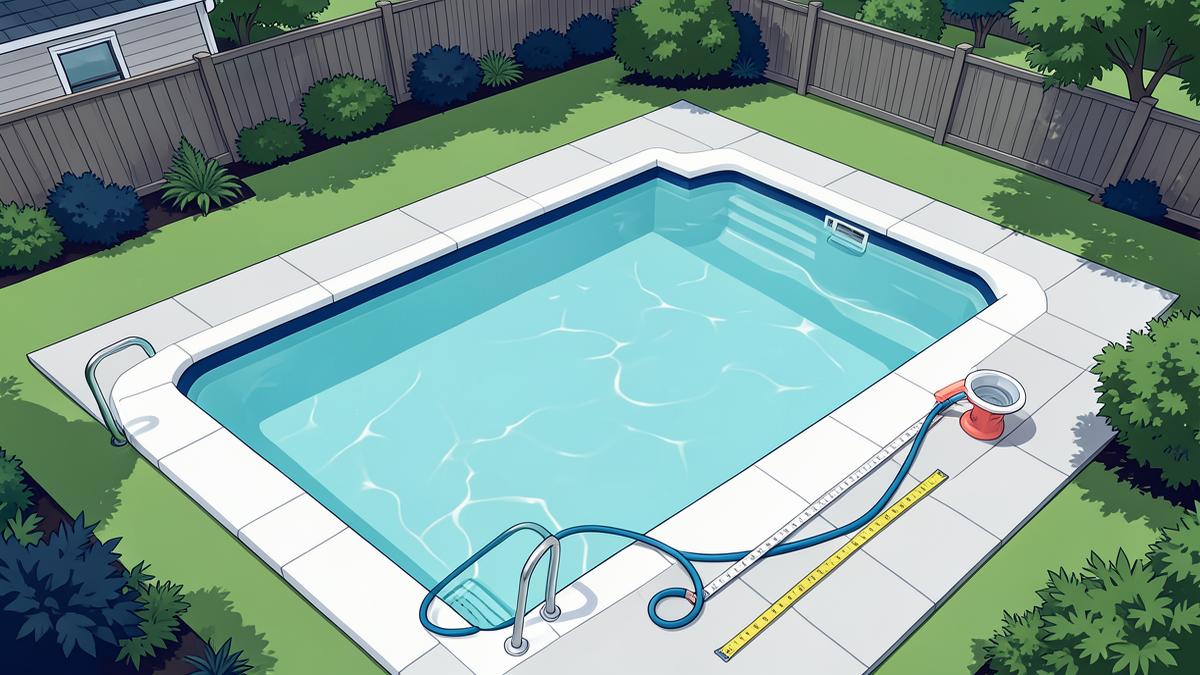
Average volume by pool type
Typical volumes seen in residential and light commercial pools
| Pool type | Typical size | Average US gallons | Average litres |
|---|---|---|---|
| Above ground round | 18 to 24 ft | 7,600 to 14,700 | 28,800 to 55,500 |
| Above ground oval | 15 x 30 ft | 10,600 | 40,000 |
| Small inground | 12 x 24 ft | 10,800 | 40,800 |
| Standard inground | 16 x 32 ft | 19,150 | 72,500 |
| Large inground | 20 x 40 ft | 29,900 | 113,300 |
| Plunge pool | 8 x 14 ft | 3,350 | 12,700 |
| Lap pool | 8 x 45 ft | 12,100 | 45,800 |
| Hotel or apartment pool | 25 x 50 ft | 46,800 | 177,000 |
| Hot tub | 7 ft round | 500 to 800 | 1,900 to 3,000 |
If your pool is close to one of these, the average is a fair placeholder while you measure. For the real figure, spend two minutes with the pool volume calculator and write the answer down once.
Why the average moves so much
Two 16 by 32 pools can differ by 4,000 gallons purely on depth. A flat 4 ft floor gives 15,320 gallons. A 3 to 8 ft slope gives 21,065. That is a 37 percent difference on the same footprint, and it changes every chemical dose, every heater sizing and every water bill.
| Depth profile on a 16 x 32 pool | Average depth | US gallons |
|---|---|---|
| Flat play pool | 4.0 ft | 15,320 |
| Shallow family pool | 4.5 ft | 17,235 |
| Standard slope | 5.0 ft | 19,150 |
| Diving pool, 3 to 8 ft | 5.5 ft | 21,065 |
| Deep diving pool, 3 to 10 ft | 6.5 ft | 24,896 |
What the average volume costs to run
These are planning ranges for a 19,000 gallon pool in a warm season climate. Local water, power and chemical prices move them a lot.
| Item | Typical figure for 19,000 gallons |
|---|---|
| First fill of water | 19,000 gallons, roughly 2,500 to 5,000 litres per hour from a garden hose |
| Fill time from a hose | 20 to 30 hours at 10 to 15 gallons per minute |
| Evaporation loss | Around 2 inches a week in summer, near 800 gallons |
| Salt to reach 3,200 ppm | About 510 lb from zero |
| Chlorine to raise 1 ppm | About 2.5 fl oz of 12.5 percent liquid chlorine per 1,000 gal |
| Turnover at 8 hours | About 40 gallons per minute of pump flow |
Check your own losses on the pool evaporation calculator and your pump target on the pool turnover rate calculator.
Average pool volume around the world
- United States: inground pools average around 19,000 US gallons because 16 by 32 is the most sold size.
- Australia: pools average about 40,000 to 50,000 litres, with 8 x 4 m a common build.
- United Kingdom: pools skew smaller, often 30,000 to 40,000 litres, and many are indoor.
- Europe: 8 x 4 m and 10 x 5 m concrete pools dominate, at 48,000 and 75,000 litres.
Use your number, not the average
Averages are fine for budgeting a build or comparing quotes. They are not fine for dosing. A 15 percent error in volume becomes a 15 percent error in every chemical you add, and chlorine, acid and stabiliser all punish that. Measure once, keep the number, then use the pool chemical calculator for doses.
Related video
average pool volume FAQs
What is the average pool volume?
A typical residential inground pool holds about 19,000 US gallons, roughly 72,000 litres. Above ground pools average nearer 10,000 US gallons.
How many gallons is an average backyard pool?
Most backyard pools fall between 10,000 and 25,000 US gallons. The 16 by 32 ft inground pool at 19,150 gallons is the most common single size in the US.
How many litres is an average pool?
About 72,000 litres for a standard inground pool. In Australia and Europe the common 8 by 4 m pool holds around 48,000 litres.
Can I dose chemicals using an average volume?
Only as a rough guess. Depth alone can shift volume by more than 30 percent on the same footprint, so measure your own pool before dosing.
More pool guides
- Pool Volume by Size: Full Gallons Chart
Look up your pool size and read the gallons straight off the chart, no math needed.
- Pool Volume Formula for Every Pool Shape
All the pool volume formulas, the constants behind them, and a worked example for each shape.
- Pool Chemical Dosing by Water Volume
Dose charts per 10,000 gallons for chlorine, pH, alkalinity, salt, stabiliser and calcium.