How the pool chlorine calculator works
Free chlorine is measured in parts per million. Raising 10,000 gallons by 1 ppm takes about 10.7 fluid ounces of 12.5 percent liquid chlorine, and the tool scales that to your pool and your product strength.
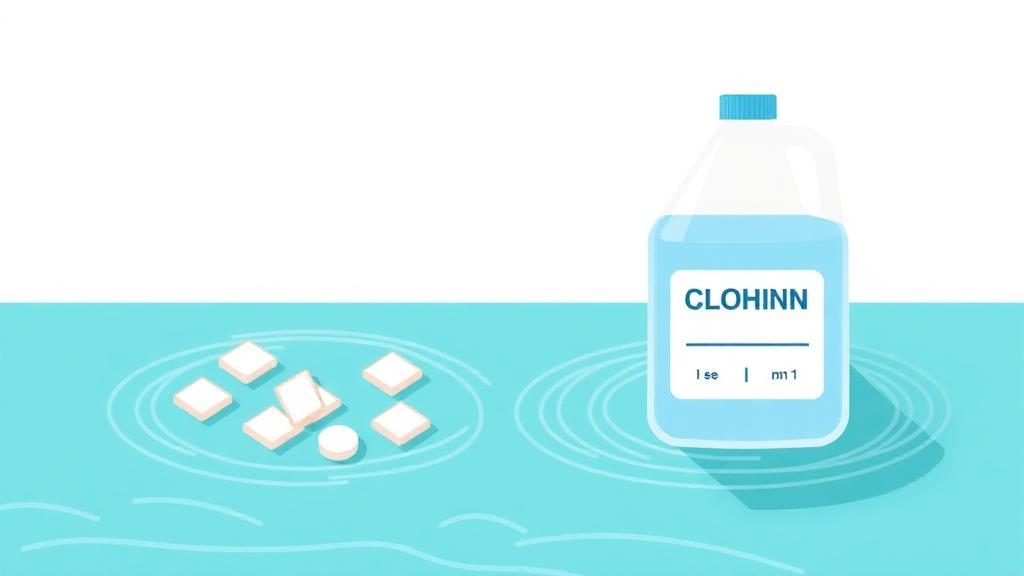
Tablets work differently. A 3 inch tab dissolves over days, so the tool converts your gap into the number of tabs that hold the same chlorine, which is a weekly plan rather than a same day fix.
The formula, step by step
Dose = ppm Gap x (Gallons / 10,000) x Product Factor
- Find your gap: target ppm minus current ppm.
- Divide gallons by 10,000 to get your pool factor.
- Liquid 12.5 percent uses 10.7 fluid ounces per ppm per 10,000 gallons.
- Cal hypo 65 percent uses 2.0 ounces of weight per ppm per 10,000 gallons.
Worked example
An 18,000 gallon pool reads 0.5 ppm and you want 3 ppm.
Gap = 2.5 ppm. Pool factor = 1.8.
Liquid dose = 2.5 x 1.8 x 10.7 = 48 fluid ounces, which is a little over a quart and a half.
Watch it done
This short video walks through the same job in real life, so you can match what you see on screen to what you do at the pool.
Tips before you start
Hold free chlorine between 2 and 4 ppm on a stabilized pool. Below 1 ppm algae gets a foothold in a single warm day.
Pour liquid chlorine slowly in front of a return jet with the pump running. Never pour it into the skimmer, since it can mix with other products in the line.
Pool Chlorine Calculator FAQs
How much liquid chlorine do I add to a 10,000 gallon pool?
About 11 fluid ounces of 12.5 percent liquid per 1 ppm. Going from 1 ppm to 3 ppm takes roughly 22 ounces.
How often should I add chlorine?
Test every two or three days in summer. A pool with proper stabilizer loses 1 to 3 ppm a day in full sun.
Are tablets better than liquid?
Tabs are easier but add stabilizer with every dose. If your CYA is already over 70 ppm, switch to liquid for the rest of the season.