How the chlorine to cya calculator works
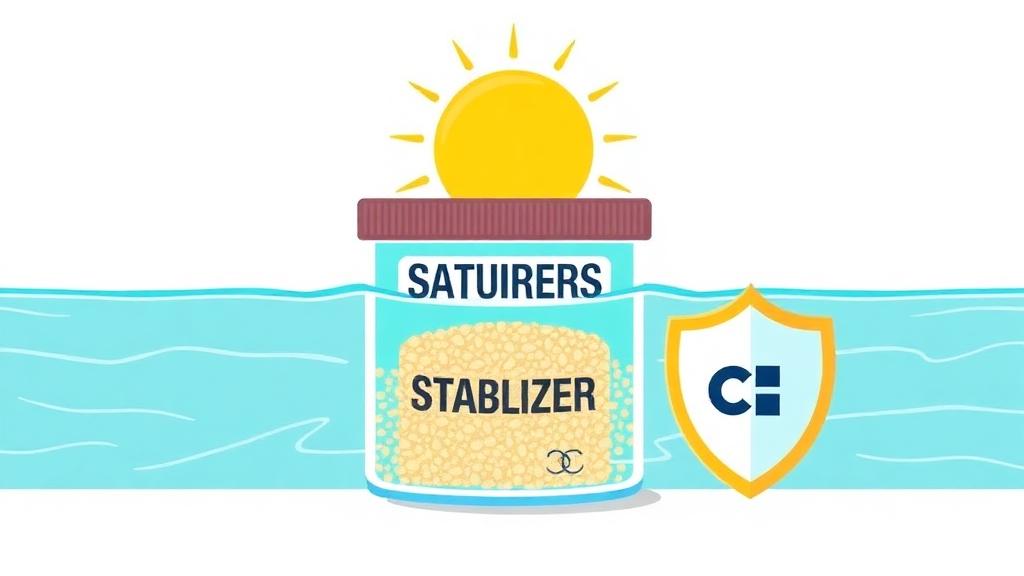
Cyanuric acid acts like an anchor for free chlorine. When ultraviolet rays hit pool water, unstabilized chlorine decomposes within two hours. CYA protects chlorine from the sun, but each ppm of CYA lowers the active hypochlorous acid concentration available to kill bacteria and algae. To maintain equivalent disinfection speed, free chlorine must scale proportionally with CYA. For baseline sanitation, see our pool chlorine calculator and pool chemical calculator.
For standard manually-dosed pools using liquid chlorine or cal-hypo, your minimum free chlorine must stay at or above 7.5 percent of your CYA level, with a recommended target of 10 to 12 percent. For example, at 50 ppm CYA, you need at least 4 ppm free chlorine at all times, with a target of 5 to 6 ppm. If free chlorine drops below the 7.5 percent threshold, algae spores begin colonizing the walls. Saltwater pools equipped with a chlorine generator can run slightly lower (roughly 5 percent minimum) because they produce a steady, continuous supply of fresh chlorine in the plumbing cell. Compare your salt needs with our pool salt calculator.
When green or mustard algae forms, you must raise free chlorine to 40 percent of your CYA reading to perform a SLAM (Shock, Level, And Maintain) process. For a pool with 50 ppm CYA, shock level is 20 ppm. Maintain that shock level continuously until water is clear, overnight chlorine loss is 1 ppm or less, and combined chlorine is 0.5 ppm or lower. If your stabilizer exceeds 80 to 100 ppm, partial draining and refilling calculated via our pool gallons calculator is the most economical way to restore sanitizer efficiency.
The formula, step by step
Minimum Free Chlorine = CYA x 0.075; Target Free Chlorine = CYA x 0.10; SLAM Shock Level = CYA x 0.40
- Test cyanuric acid level using a reliable turbidity tube test kit.
- Read your current free chlorine and combined chlorine in ppm.
- Select your pool sanitation type: standard chlorine or saltwater chlorine generator.
- Check the calculated minimum free chlorine threshold. Never let free chlorine fall below this mark.
- Dose liquid chlorine or cal-hypo to hit the recommended daily target range.
- If treating visible green algae or failing an overnight chlorine loss test, dose to the SLAM shock level.
- Keep the filter running continuously and brush all pool surfaces twice daily until water clears completely.
Worked example
A 20,000 gallon in-ground pool tested at 50 ppm cyanuric acid (CYA) with 1.5 ppm free chlorine.
Minimum free chlorine threshold = 50 x 0.075 = 3.75 ppm (round to 4 ppm).
Daily target maintenance level = 50 x 0.10 = 5 ppm (range 5 to 7 ppm).
Current chlorine (1.5 ppm) is below minimum, putting the pool at immediate risk of algae.
To raise free chlorine by 4 ppm (from 1.5 to 5.5 ppm): add 85 fl oz (0.66 gallons) of 12.5% liquid chlorine.
If pool has active green algae, SLAM shock level = 50 x 0.40 = 20 ppm free chlorine.
Free chlorine minimum, target, and SLAM shock levels across cyanuric acid (CYA) readings
| CYA Level (ppm) | Standard Min FC (ppm) | Standard Target FC (ppm) | Saltwater Target FC (ppm) | SLAM Shock Level (ppm) |
|---|---|---|---|---|
| 20 ppm | 2 ppm | 3 to 5 ppm | 3 to 4 ppm | 10 ppm |
| 30 ppm | 2.5 ppm | 4 to 6 ppm | 3 to 5 ppm | 12 ppm |
| 40 ppm | 3 ppm | 5 to 7 ppm | 4 to 6 ppm | 16 ppm |
| 50 ppm | 4 ppm | 6 to 8 ppm | 4 to 7 ppm | 20 ppm |
| 60 ppm | 5 ppm | 7 to 9 ppm | 5 to 8 ppm | 24 ppm |
| 70 ppm | 5.5 ppm | 8 to 10 ppm | 6 to 9 ppm | 28 ppm |
| 80 ppm | 6 ppm | 9 to 11 ppm | 6 to 10 ppm | 31 ppm |
| 90 ppm (High) | 7 ppm | 10 to 12 ppm | 7 to 11 ppm | 35 ppm (Drain advised) |
| 100 ppm (Lock risk) | 8 ppm | 11 to 13 ppm | 8 to 12 ppm | 39 ppm (Drain advised) |
Tips before you start
Cyanuric acid does not evaporate. The only ways to lower high CYA are by draining water and refilling with fresh tap water or using specialized reverse osmosis filtration.
Trichlor pucks add 6 ppm of CYA for every 10 ppm of free chlorine they introduce. Switching to liquid chlorine prevents stabilizer levels from climbing out of control.
If your CYA exceeds 90 ppm, sunlight protection benefits plateau while chlorine demand escalates drastically. Plan a partial drain to bring CYA back to the 40 to 60 ppm sweet spot.
Never use yellow mustard algae algaecides with high ammonium compounds without first confirming your free chlorine can handle the subsequent ammonia demand.
In-Depth Step-by-Step Guides
Read our field-tested tutorials for exact chemical formulas, equipment sizing, and troubleshooting:
Chlorine to CYA Calculator FAQs
What is chlorine lock and how does cyanuric acid cause it?
Chlorine lock occurs when cyanuric acid accumulates beyond 90 to 100 ppm, usually from continuous use of stabilized trichlor tablets or dichlor shock. At high CYA levels, chlorine molecules become bound so tightly to stabilizer that free chlorine cannot sanitize fast enough to prevent algae, even though test strips show adequate chlorine.
What is the ideal CYA level for a residential swimming pool?
For standard pools using liquid chlorine, the ideal cyanuric acid level is 30 to 50 ppm. For saltwater pools with an automatic chlorine generator cell, the ideal range is 60 to 80 ppm because the stabilizer prevents the generator from running at excessive wear levels.
How does the SLAM method differ from ordinary pool shocking?
Traditional shocking involves dumping one or two bags of shock in the water once a week and letting chlorine fall back down. SLAM (Shock, Level, And Maintain) holds free chlorine at 40 percent of your CYA level continuously for multiple days with 24/7 filtration until all algae cells and organic contaminants are completely eradicated.
Why does a saltwater pool need a lower chlorine-to-CYA ratio?
Saltwater chlorine generators produce free chlorine steadily throughout the daily pump run time. Because sanitizer is generated continuously rather than added in batch doses, salt pools maintain consistent residuals with a slightly lower baseline ratio of 5 to 6 percent of CYA.
Industry Standards & Authority References
Calculations and safety recommendations are verified against published consensus guidelines:
- CDC Healthy Swimming: Cyanuric Acid and Chlorine Stabilization Guidance
- Pool & Hot Tub Alliance (ANSI/APSP/ICC-11): Standard for Swimming Pool Water Quality
- U.S. Environmental Protection Agency: Disinfection of Swimming Pools and Spas