
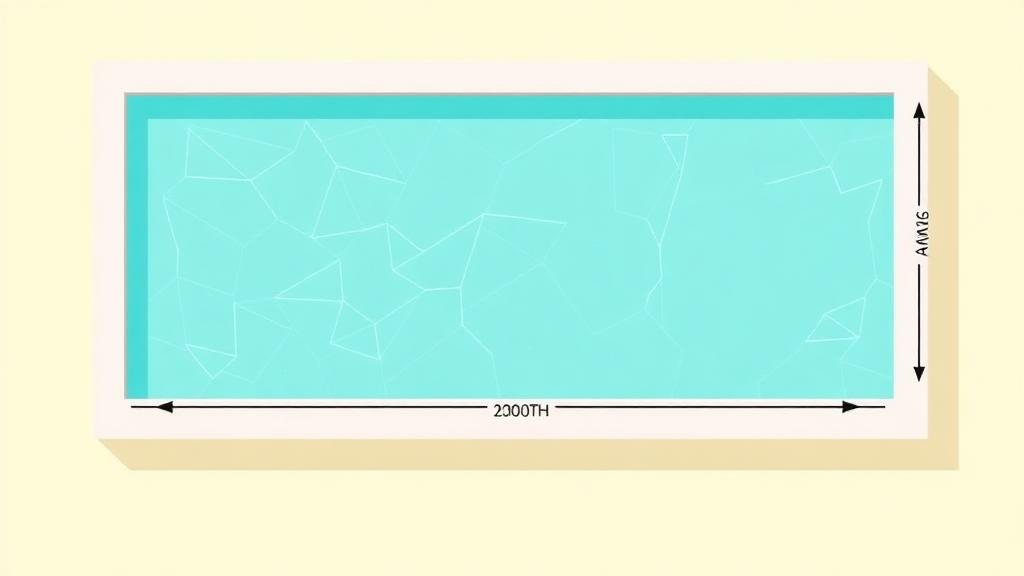
How the freeform pool volume calculator works
Multiply maximum length by maximum width, then by 0.785 for the curved outline. Multiply that area by the average water depth.
For a very irregular pool, split it into two or three simple sections, calculate each one, and add the results together.
The formula
Estimated volume = maximum length x maximum width x 0.785 x average depth
Measure: Maximum length, maximum width, average depth.
Worked example
A freeform pool 28 feet long and 16 feet wide gives 28 x 16 x 0.785, which is 351.7 square feet.
At an average depth of 4.5 feet that is 1,582 cubic feet, roughly 11,838 gallons or 44,810 litres.
Tips before you measure
Take the two measurements at the widest and longest points of the water surface.
Check the estimate against your filter turnover time. If the water clears slower than expected, your real volume is probably higher.
Freeform / Irregular pool volume FAQs
How do I calculate an irregular pool?
Use maximum length times maximum width times 0.785, then multiply by average depth. Split very odd shapes into sections.
How exact is the answer?
Expect 5 to 10 percent either way. That is fine for chemicals, filters and heaters.
Is there a more precise method?
Yes. Refill through a meter and record the reading, or add a known dose of chemical and test the change.
Other pool shapes
Not quite the right outline? The main pool volume calculator covers all 20 shapes with the same units and formulas.